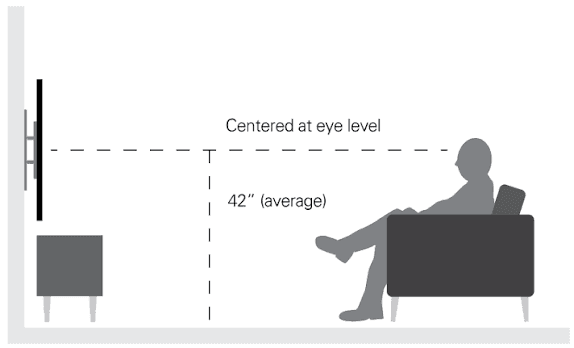
Mount the TV so the center of the screen is at eye level when you sit where you watch most. In most living rooms that is about 42 inches from the floor, and with a tilting bracket we usually go 5 to 10% higher, which is only 2 to 4 inches. Our technicians ask where you want the TV before every install, and if the spot you picked is too high or too low, they suggest a better one.
Many customers don't know exactly where they want the TV, and that is fine. Some ask for a spot that is very high or very low, so we treat the height as a short conversation before we drill. Here is what we weigh, what the published guides say, and the numbers we use.
Based on our own installs across Miami-Dade, Broward and Palm Beach counties. Last updated October 2026.
The short version
| Where the TV goes | Center of the screen | Bracket |
|---|---|---|
| Living room, watched from the sofa | At eye level: about 42 inches from the floor for most sofas | Fixed |
| Living room, tilting bracket | 5 to 10% above eye level: about 44 to 46 inches | Tilting |
| Bedroom, watched from the bed | At the eye level of the person who watches most, measured from the bed | Tilting if it ends up high |
| Far above eye level, such as over a doorway or fireplace | As low as the space allows, tilted down toward the seats | Tilting |
What we weigh before we drill
Before every install, our technician asks where you want the TV and gives advice. Five things decide the height:
- Where you watch from. Mostly the sofa or the bed, in a living room or a bedroom.
- How far away that spot is. The farther you sit, the less a few inches of height matter.
- What sits under the TV. The height of the dresser, console or stand sets how low the screen can go.
- How big the TV is. A bigger screen is taller, so its bottom edge hangs lower.
- Which bracket you chose. A fixed bracket stays where it is mounted, while a tilting bracket can aim the screen back at you.
If the first idea is very high or very low, we say so and suggest a better spot. We would rather change the plan before the first hole than after it.
Why eye level is the starting point
THX says your line of sight should be roughly in line with the center of the screen, and suggests keeping the angle to 15 degrees or less above or below it. It also cautions that raising a TV can hurt picture quality on modern 4K sets. On a sofa, the usual figure for seated eye level is about 42 inches from the floor: Sanus calls it the industry guideline, and CE Pro and Bob Vila agree.
Your sofa and your height can move that number by a few inches, so the safest rule is to sit where you watch and measure from the floor to your eyes. If several people watch together, Bob Vila suggests averaging their eye levels. You will also see charts that put the center of a 55-inch TV at 60 inches or more. We don't start from a chart. We start from where you sit, and we go well above eye level only when the wall or the furniture forces it.
A few inches above eye level costs almost nothing. This table shows the angle from your eyes to the center of the screen, by how far above eye level the TV hangs and how far away you sit. For reference, a common rule puts you about 8 feet from a 55-inch TV and about 10 feet from a 65-inch one (the diagonal divided by 0.55, according to CE Pro).
| TV center above eye level | 6 feet away | 8 feet away | 10 feet away |
|---|---|---|---|
| 4 inches | 3° | 2° | 2° |
| 10 inches | 8° | 6° | 5° |
| 24 inches | 18° | 14° | 11° |
Four inches, the top of our tilt rule, is only 2 to 3 degrees, far inside THX's 15. Ten inches above eye level at 8 feet needs about 6 degrees of downward tilt, the example we work through in our story about a 55-inch TV above a doorway in Coconut Creek. Two feet above eye level is already 14 to 18 degrees from a seat 6 to 8 feet away, and a TV over a fireplace can hang at least that high, so we always use a tilting bracket there (see our above-fireplace guide for Fort Lauderdale).
Fixed or tilting?
On a fixed bracket the TV hangs flat against the wall and can't change angle, so the center goes at eye level. A tilting bracket lets us angle the screen down, so we usually go 5 to 10% higher than eye level, which on most sofas means 2 to 4 inches. Tilting also helps cut glare when the TV sits high. Full-motion brackets suit rooms where you watch from more than one spot. If you add our bracket, it is $39 for fixed, $49 for tilting and $69 for full-motion, and $0 if you bring your own; see how our pricing works.
Furniture and TV size
A 16:9 screen is about 49% as tall as its diagonal, so a bigger TV hangs lower when its center is at eye level. With the center at 42 inches:
| TV size | Screen height | Bottom edge | Furniture height that leaves a 4 to 6 inch gap |
|---|---|---|---|
| 55″ | 27″ | 28.5″ | 22 to 24″ |
| 65″ | 32″ | 26″ | 20 to 22″ |
| 75″ | 37″ | 23.5″ | 17 to 19″ |
| 85″ | 42″ | 21″ | 15 to 17″ |
Heights are for the screen only, and the frame adds a little. Guides ask for 4 to 6 inches between the top of the furniture and the bottom of the TV (CE Pro and Bob Vila both say so), and a soundbar under the TV takes its own height on top of that. If your dresser or console is taller than the last column, the center has to go higher, which is one more reason to choose a tilting bracket.
Bedrooms: measure from the bed
A bed is the hardest spot to get right. You might be sitting up against the headboard or lying back on pillows, and either way your eyes are usually lower and further back than on a sofa. Published guides give different bedroom heights, so we don't use one bedroom number. The person who watches most gets into their usual position, and we measure from the floor to their eyes.
Then the room sets the limits. On a 43-inch TV over a bedroom dresser in Coconut Creek, we set the height from the dresser and the bed's actual position, because living-room math would have left the TV too high. On a 75-inch TV under a vaulted ceiling in Boca Raton, we measured exactly where the slope begins and kept the TV high enough to watch from the bed and low enough to clear the angle with real margin. When the dresser pushes a bedroom TV higher than the eyes of someone lying back, a tilting bracket helps.
Too high, too low
- Too high. Looking up through a whole movie gets tiring, and THX warns that raising a TV can hurt the picture. Two published limits help: THX suggests keeping the angle to the center of the screen within 15 degrees, and Bob Vila, citing SMPTE, says you should not have to tilt your head up more than 35 degrees from eye level to see the top of the screen. When the wall forces a high spot, such as over a doorway or a fireplace, the answer is a tilting bracket and the lowest height the space allows.
- Too low. A TV that hangs too low makes you look down at it (THX's 15 degrees applies below the center too) and leaves no clearance above the furniture. We would rather lift the center a couple of inches, with a tilting bracket if needed, than squeeze the 4 to 6 inch gap.
Decide before the first hole
Moving a TV later leaves the old bracket holes in the wall, and drywall patching is not included in our price. It is much easier to agree on the height with the technician before anything is drilled.
Not sure where your TV should go?
You don't have to decide in advance. Book online or call (754) 340-1000, tell us where you sit, and the technician will suggest the best height before drilling. Same-day or next-day installs are often available in Miami, Fort Lauderdale and West Palm Beach, subject to availability.
Related: What Is Your Wall Made Of? TV Mounting by Wall Type in South Florida and How Much Does It Cost to Mount a TV in South Florida?